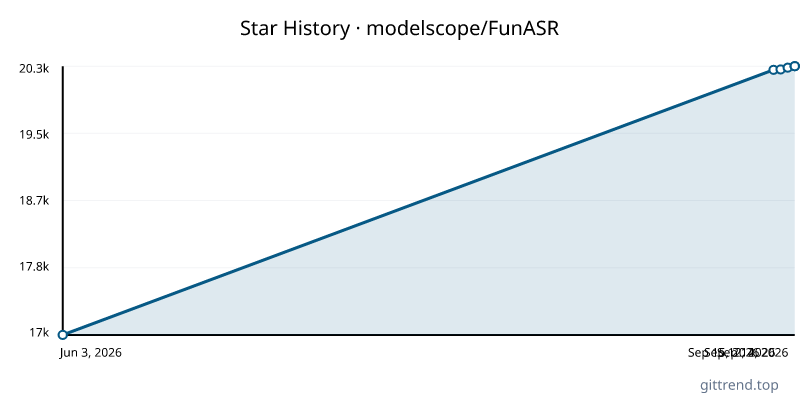
Overview
FunASR is an industrial-grade, end-to-end speech recognition toolkit engineered for high performance and broad applicability. It delivers exceptional speed, multilingual support, and advanced audio processing capabilities, all accessible through a unified API. FunASR is designed to be a fundamental tool for developers and organizations seeking robust and efficient speech-to-text solutions.
Key Features
- Blazing Fast Performance: Achieve speeds up to 170x real-time, significantly outperforming alternatives like Whisper. Even on CPU, FunASR models offer competitive speeds, with some reaching 17x real-time.
- Extensive Language Support: Transcribe audio in 50+ languages, with advanced models like Fun-ASR-Nano supporting 31 languages and automatic language detection for a wider range of 52+ languages.
- Comprehensive Audio Analysis: Beyond basic transcription, FunASR offers integrated speaker diarization (identifying who spoke when) and emotion detection (recognizing happiness, sadness, anger).
- Streaming Capabilities: Process audio in real-time with low latency streaming support, ideal for live transcription applications.
- Unified & OpenAI-Compatible API: Deploy FunASR as a server with an OpenAI-compatible endpoint, simplifying integration with existing AI agent frameworks and applications like LangChain, Dify, and AutoGen.
- Advanced Model Architectures: Leverage state-of-the-art models including SenseVoice, Paraformer, and LLM-based solutions like Fun-ASR-Nano, offering flexibility for different accuracy and performance needs.
- vLLM Acceleration: Experience up to 2-3x faster LLM decoding with the integrated vLLM inference engine for enhanced throughput.
- Self-Hosted & Flexible Licensing: Benefit from the MIT license, enabling full control and cost-effectiveness for self-hosted deployments.
Typical Use Cases
- Real-time Transcription: Power live captioning for meetings, webinars, and broadcasts.
- Meeting Analysis: Automatically transcribe meeting recordings, identify speakers, and extract key discussion points.
- Customer Service Enhancement: Analyze call center interactions for sentiment, agent performance, and compliance.
- Content Moderation: Transcribe and analyze user-generated audio content for policy violations.
- Accessibility Solutions: Provide real-time transcription and audio descriptions for users with hearing impairments.
- Voice Assistants & Agents: Integrate robust speech recognition into AI assistants and agents for natural language interaction.
- Audio Data Preprocessing: Efficiently prepare large audio datasets for further analysis or model training.